
Day 27: Crime and Punishment
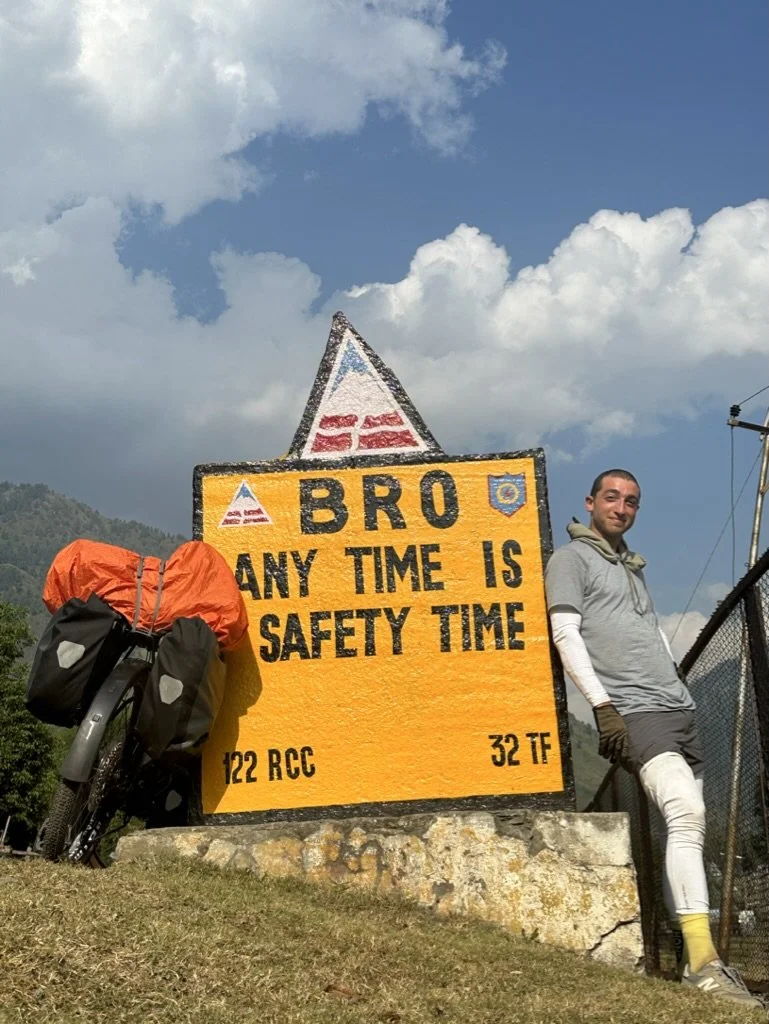
For the first time in many days, I slept soundly. I awoke late at around 9:30AM. No hangover. It was freezing in the room and difficult to convince myself to get out from under the covers. I made it to the bathroom and was happily surprised by a perfectly solid bowel movement. Did I beat my SIBO? Only time will tell. If there’s one thing I’ve learned while battling this illness, it’s to avoid any premature celebration. Adam and I set off in the pursuit of breakfast and had a scrumptious mutton momo thukpa with some heavily gingerized milk tea that warmed our hearts and souls. When we got out the wind was howling and blowing dust everywhere. Many people were wearing face masks, it was an ominous scene. We looked at each other, thinking of the bike journey ahead, and dreading at the idea of that wind continuing to blow opposite the direction of our destination. We could be in for a rough one. We bopped around the market buying bananas and chocolate for the journey and stumbled upon a cute little cafe that served baked goods and real coffee and Korean food. The owner was a gregarious man from Manali who happily entertained us and gave us some important intel about the road that lay ahead as we drank espresso and ate banana chocolate cake. There’s an epic monastery called Phuktal on the way but to visit it we would need to favor a bumpy road over a smooth one and then park our bikes and hike out a few hours. Of course I’m obsessed with the idea but Adam would rather stick to the tarmac. He’s not so easily charmed by these monasteries. I anticipate we will come to a resolution only once we reach the fork in the road. The man had married a Korean woman which explained why there was bibimbap on the menu and they had a cute little daughter. He gave us his contact should we ever need any help once in Manali. This is actually his last day before he closes shop and heads back home over Shinkula, the pass we have yet to climb. It’s October now and the season’s virtually over, and it’s anyone’s guess when a snow storm will permanently close our pass. In fact, perhaps I already mentioned, but the Leh-Manali highway closed to two feet of snow recently meaning that Adam is very lucky he met me and that I convinced him to take the unorthodox way to Manali, otherwise he’d have had to board a flight out of Leh or go back out through the Srinagar-Leh highway. We went back to the hotel to escape the cold and wind but the power is off here too and so we’re back under the covers waiting for the electricity so we can take hot showers. There’s another loud group of Australian motorcyclists in the lobby, the third we’ve encountered in two days. Why are there so many groups of middle aged Australian men riding motorbikes out here? It’s off putting to say the least.
I’m thinking a lot about Crime and Punishment. There’s something tragically and humiliatingly relatable about Raskolnikov, like looking into a mirror and seeing something unflattering, and I’m wrestling with it. This guy perfectly represents the sore loser complex of someone who grew up believing they were destined for greater things and then blames the world around them for their failure. Someone who despises society and would rather self isolate and reject their family and friends than find some way to make ends meet in a more ordinary and realistic fashion. Ugh, it me? The way Raskolnikovs mother cries and stubbornly offers him her unconditional love reminds me of the way my own mother cried when I left for this trip, strongly hinting that it risked to be a long one but being ambiguous much the way Raskolnikov was. It’s always sad to torture your mother like that. Our mothers know us best, and just by looking at us they see the turmoil brewing in our minds, and they cry for we are not well. Raskolnikov articulates how the boldest thing a man can do is take a step in a new direction. Taking a new step, uttering a new word, is what people fear most. How true! And how difficult it’s been for me to try expressing this idea. It’s so hard to think a thought that is genuinely new to you and choose to adhere to it. But where I diverge, is that I believe there are no new thoughts to think. Most of the big thoughts about life and how to live it have already been thought and written down for us, and we know the most important ones. It’s just realizing their truth that takes the time and the work, and genuinely living by it that’s nearly impossible. Some of the most difficult ideas to live by are very old ideas so often repeated that they have become cliché. How many songs tell us about how important love is? The Beatles said “all you need is love” and “money can’t buy me love” and Jackie DeShannon told us it’s all the world needs and the Black Eyed Peas asked us where it was so we’ve all heard it and we know it’s important and all remember it but do any of us really know it or realize it or believe it? It’s difficult to realize something on your own when the conclusion has already been presented to you, and it takes work and years of experience to come to such a stupid and boring conclusion as “all you need is love” and yet it’s possibly the truest most powerful conclusion a human could ever have! I feel of love the way many may feel towards God. I don’t know it per se, haven’t exactly seen it, I’ve felt it only in a few incredible moments of my life, but I feel inclined to believe that it is the ultimate thing and the divine presence and what we should all be driving ourselves towards. But to take it a step further and live this idea, that could make you a radical. That could make you dangerous and cause people to distance themselves from you. Take the ideology of being a liberal or a socialist, for example. Most of the values in these ideologies are good and true and based in a love ethic and we’ve agreed on their goodness and truthfulness, yet no one is going out of their way to practice these principles. If I’m at a party talking with someone and I say you know this system isn’t working and we need to create a better world that values love over all other things they would say hell yeah lets do it. But then if I sharpened my eyes and took up a serious tone in my voice and put my hand on their shoulder and said “seriously, let’s do it. Let’s start meeting every Tuesday and discuss how we’ll recruit new members” they’d think okay this guys fucking sketchy I’m going to excuse myself to go to the bathroom or get another drink. When a person experiences an intense realization about one of these deeper truths about life and then actually genuinely wants to live by it and act on it, often times their eyes glow and they speak in a way that makes the good folk of society uncomfortable and it separates them from society and it can be hard for them to ever go back. “Yeah that guy changed, he’s just not himself, went off the deep end”. If the Quran says that all the infidels should be killed or forcibly converted, and you as a muslim aren’t making that your life’s work, then you’re a fraud to call yourself muslim, you’ve become cynical and you clearly find your religion dubious if you aren’t taking every word literally. But by all means, please be a fraud! Like I said before, religion should absolutely be half if not quarter or even fifth assed. So called liberals and socialists, on the other hand, your fraudulence is not so appreciated. Moral ideology should be as full-assed as possible.
Liberals are apathetic and scared and comfortable. And it’s all they can afford to be. No one wants to make a big fuss, it’s embarrassing to care. We all love a person that keeps their head down and works hard and is stable and not too loud and not selfish and generally thoughtful and trustworthy and just kind of wants to be socially accepted and that’s it. Nobody wants to be friends with a revolutionary, or someone that tries to live purely by their moral philosophy, that’s fucking cringe. Hell, people hardly want to be friends with an entrepreneur, they’re annoying too but for opposite reasons. People don’t like change and subversive ideas, even if it’s the same idea you already believe in just being taken seriously. This is especially inconvenient to them if they are benefitting from the system in place just fine or blind to their own suffering. To these people, the revolutionary is seen as someone who took too much acid, a heretic, an imbecile, a child, etc… They don’t “get it”. “Yeah I used to think that way too, then I grew up”. We are expected to grow out of our desire to see our values manifested, we’re expected to become moderates and conservatives in our age as we invest in property and pay taxes and embrace selfishness. These so called revolutionaries don’t understand how life is supposed to work. They aren’t someone to do business with or trust to watch your cat and water the plants for the weekend. The good folk of society pretend that they share the views espoused by the revolutionary, views so often repeated that they’re cliches and platitudes. But they subscribe to these views with as much piety as a proud catholic Italian in the mafia who wears a gold cross necklace while he extorts and murders. And as believers of the liberal faith, we focus much more on wearing the cross and making appearances at church, so to speak, than abiding by its principles. We put a great deal of energy into the taxonomy of identities and voicing our virtue in the cavernous echo chambers of social media, debating what word we’re supposed to use this month, but very little energy goes into tangible social change. We are hesitant because it is a value system that, if actually practiced, would severely impede our ability to attain the good life, which is what we all want. How many women have I been on dates with who have claimed to “hate capitalism” but work in marketing and are good at marketing and love their jobs and their one complaint is that they want to make more money? It’s like a Muslim telling me they love their job at the bacon factory. Let’s look at the summer of 2020. Did any white people actually genuinely want or try to change the system to bring up black folks? Did white people actually try to give up their privilege, if such a thing were even possible? No, the focus quickly shifted to “acknowledging” privilege. Instead of turning into a disruptive social movement to rearrange power structures, it became a confessional, with white people in the spotlight having their come to Jesus moment reflecting on their sins and begging for absolution. And that was just wonderful… for white people. They got to walk away feeling just fine about themselves because they read How to be Antiracist and White Fragility and they wrote moving posts on Instagram which got tons of likes and they listened and they learned, and the work was done after that. It was a diversion, a publicity stunt, a scam. The logic of capitalism would never allow white people to actually give up their privilege, that would just be stupid. What do you want me to do when I apply for a job? Write a cover letter saying by the way if there’s a black applicant definitely take them and not me? No, of course not, you want that job, and if you having the job means the black person doesn’t have the job so be it. Capitalism teaches us to capitalize on every advantage we have, because if we don’t someone else will. Nothing tangible came out of the summer of 2020, but now you can put BLM or ACAB in your Instagram or Tinder bio to show everyone what kind of person you are.
Without socialism, without love, there is no way to substantially improve the lot of Black Americans or any other oppressed group. Abolish the police is well meaning but makes no sense. The police are a symptom, not the disease. Abolish capitalism in its current insidious form, abolish the culture of toxic individualism, and the police will go away on their own. And on the subject of capitalism, because the word gets thrown around so much as if this one word somehow encapsulated all the evil and bad things in the world, capitalism is just fine! We need it, it’s efficient and as the Russians and Chinese taught us if you try to get rid of it really fast bad stuff will happen to the tune of millions dying in famines. There’s nothing inherently wrong with capitalism. It’s just the cultural and ethical context within which we practice capitalism that needs to change yesterday. We currently have a predominant culture of toxic individualism pervading all aspects of life in America. Toxic individualism is what informed our narrow-minded economics, where we make calculations in an artificial simulation where there’s no environment, human happiness doesn’t exist, and love doesn’t exist: The economics that enabled corporations to reek death, destruction, and despair on our lovely little planet. This must be replaced with a love ethic. Don’t ask me how, I don’t even know how to love. I wish I did. But I never learned. And so I’m just as much a part of the problem as everyone else. I just know that I want to love and be loved, and that if love was the bottom line and not the individual, capitalism would become beautiful. No more scams, no more tricks and foul play and poisoning wells and destroying the environment. With love as the incentive we’d thrive. How many brilliant young minds are sent to Harvard, and from there to Goldman Sachs? What a waste of intelligence, being used for the singular purpose of maximizing wealth. Imagine all these strong minds being harnessed through love of humanity to fight climate change and solve the other issues our world grapples with. But again, not sure how to make it work. I read the Bell Hooks book, and I’ve read many other moral/philosophical/economics books such as Debt by Michael Graeber and funnily enough they always end with the same conclusion: the world needs more love. Humans want to love, they need to love, humans are naturally communal and loving and we’ve been ripped out of our contexts and encouraged to become these sociopathic individualists. I desperately want to understand love and do love, but so far I’ve only done toxic individualism and it hasn’t brought me much in the way of sustainable happiness. Sometimes I wonder if it’s too late for me, or if I have some mild form of Aspergers. Maybe I’ll learn to love, maybe I won’t. But what I do know is that without a love ethic, and a good amount of socialism, we will never solve the climate crisis, we will never solve economic inequality, we will never solve the rise in depression and deaths of despair, and we will never solve Americas racial woes. Toxic individualism makes a person who has all the resources they need to live a happy healthy life feel miserable for not achieving more, it is a disease of the mind that infects us and makes us addicts. Capitalism can be a wonderful anti-depressant, it is fun and exhilarating and challenges us to try harder and be better and more efficient. Of course it’s more fun to play career person in New York than it is to rot in your small town. But capitalism, if used for the wrong reasons, is like cocaine. Every time you get that kick, in 15 minutes you’re going to realize you need some more, and it’s going to use you up. It’s designed to never leave you feeling satisfied for long. Love, on the other hand, is satisfying, because it is a feeling that is always growing within you the more you invest in the people around you and the more of yourself you give to them. Love doesn’t need to be an addiction. Love should fill your soul like a warm soup and sing you to bed at night. We all want that. That’s why people take Molly, it makes you feel like you love and are loved. But that is artificial, and you will feel like shit the next day unless you’re one of those people that knows all the supplements you’re supposed to take. Toxic individualism would be hard to uproot, if not impossible. It’s so much a part of who we are that it’d have a dramatic effect on our identities as Americans to do away with it. And, given the size of our population, toxic individualism unfortunately makes sense. We are too many people competing for too few resources. It’s as if we were 20 piglets, and momma pig only has 8 udders, so we are all endlessly competing for our turn to suck on one of those teets and get that delicious pig milk. We bite and shriek at each other, pushing our way in, desperately needing that milk, and all we can really care about is ourselves, for our survival is at stake and that milk will determine whether or not we develop into full pigs or runts. And momma pig suffers, because she just wants all 20 of her children to get her milk, but she is powerless. Of course, all 20 piglets could look at this problem, and look at each other, and say are we not all brothers and sisters? Why can’t we devise a system where we distribute time at the teet equitably? We can all grow strong together, there needn’t be runts. But that doesn’t happen. What’s more likely to happen is that one or two exceptionally ambitious piglets will hog the teets and get the most nutrition for themselves, becoming ultra pigs, and they’ll use their power to control the other piglets who will all become subservient runts. And would it really be different if there were, say, 8 piglets, one for each teet? Would there be some utopia there? Probably not. Once again, ambitions would arise. The ambitious piglet would trick one of their siblings into taking out a milk loan that they can’t repay and falling into their debt, then the piglet would repossess their bankrupt siblings teet and rent it back out to them, and by doing so eventually monopolize all the teets. But we are not pigs. We are capable of love. We can be better than pigs, I do believe that.
I think I digressed again. So to sum up, we liberals have a very firm idea of our religion, what values we should say we adhere to, what opinions we know are safe and good to express, but in practice we cynically worship money and prevent ourselves from taking any big idea further than a cute little discussion at the dinner table after a few glasses of wine. The liberal movement is in need of some kind of protestant reform, who will be our Calvin, our Luther? I propose an ultimatum: either liberals find a new religion that actually reflects their actions or lack thereof, or they start practicing theirs, no more bullshit. Raskolnikov is driven to madness because he is an ideological purist, he does want to be different and be great and change things, and that makes him dangerous and he does do bad things as a result. Maybe Dostoevsky is warning us not to be the fanatics of our own beliefs? Ted Kaczynski was a mad man too, but he also sort of had it figured out didn’t he? But that didn’t excuse his crimes. Unless, of course, it had worked and he had pioneered a revolution, if he had become Napoleon, then we’d look at those mail bombings as a regrettably necessary start to something beautiful. Perhaps if Hitler had won and created some kind of Jewless Utopia, we’d all look up to him and exonerate him for his crimes as well, not me because I wouldn’t be there and then no one would have to read this, what a world it could’ve been! But in most cases, mad men are just that, mad men. Maybe we are right to cast out such people and regard them with disdain. Maybe it is preferable to pretend we care about our values but to live our lives in spite of them. It certainly seems to be the prevailing strategy in the world of big city liberals that I happen to be familiar with. But we are so helpless. I can’t blame us. We need to survive too. We walk all over the poor because that’s how it works and better us than them. We deserve the computer job with the air conditioning and they deserve the cleaning and the cooking and manual labor and that’s just how it is. We read the news every day. We see what’s happening in the world. We know we’re living in a thinly veiled caste society. We know the climate crisis is getting worse and worse and will be our doom. We perform guilt about the whole thing in public and shake our heads and sigh over our IPAs and say but what can be done? So we focus on what we can control: our social media presence and the compost bin. But sometimes I wonder. If the revolution did come to our doorsteps one day… what would we do? Would we hide inside and secretly hope it’s quelled while feigning support on instagram? Or would we join the front lines and give up our relatively cushy places in society: forget the mortgage, the ETFs and the mutual funds and the six figure salary and the vacations and the benefits and the restaurants and cocktails and brunches and concerts, throw it all away, for something different? For less material indulgence? Would we take that chance, on the wager that it might lead to a better world for all?
Is this trip my crime or my punishment or my absolution? Is this the murder or is it the fever or is it Siberia? Are my chronic injuries and malaises some kind of self-inflicted torture for thinking myself better than others and wanting to leave society, much like Raskolnikov’s post-murder fever? In a twisted way, he only comes to terms with his failure to be the next Napoleon when he finds himself unable to take any advantage of the spoils of the murder, hiding away the purse and jewels and never going back to see what they were worth. He didn’t think much of the lives he’d taken, and yet his sense of morality and religion caused him grievous illness and guilt and prevented him from using it as a stepping stone to power that would theoretically have such a positive effect on the world that it would excuse the initial and necessary sin. So intellectually he felt justified but physically and spiritually he loathed himself. Much like how I feel intellectually justified in quitting my job and leaving New York and seeking out something different, but at times I feel pangs of guilt and humility for the crimes of abandonment and selfishness and narcissism and privilege and unoriginality. And I am a murderer. I’m murdering my past self, rather violently, because he was pathetic and corrupt and quite sad and anxious and helpless so I say good riddens to him!… But will Nick 2.0 really be any different? Or is the old saying “wherever you go, there you are” going to be my truth in the end? Raskolnikov grappled with suicide but was thwarted by his stubborn youthful will to live, as Dostoevsky illustrates beautifully: “Where is it I've read that someone condemned to death says or thinks, an hour before his death, that if he had to live on some high rock, on such a narrow ledge that he'd only room to stand, and the ocean, everlasting darkness, everlasting solitude, everlasting tempest around him, if he had to remain standing on a square yard of space all his life, a thousand years, eternity, it were better to live so than to die at once. Only to live, to live and live! Life, whatever it may be!” I think we often find ourselves in life standing on that square yard, contemplating the easy jump to end it all, and choosing instead to live. And who among us that travels, and I mean really travels, hasn’t contemplated suicide? Is traveling not an exciting and logical alternative to suicide for those who hate their lives but still want to live? For when we travel, we do virtually murder ourselves and attempt to start anew. Just as when you eat mushrooms or acid and momentarily kill your ego, then reassemble all the little pieces of yourself that make up your consciousness and in the process become a different person. And the logic of a suicidal person, one who truly hates themself and can’t possibly bear to go on living the way they are, in the best case it will lead to a major life change. Change is much more exciting and productive and reasonable than just killing yourself isn’t it? And it’s always available to us, we just need to take that first step. And it’s much more fair to all the people in your life who love you and support you, a brilliant compromise I would say. How cruel and selfish to kill yourself when your parents love you and wish the best for you. There’s no honor in that, and you will always leave a huge debt that can never be repaid to all the people that helped you grow and all the resources you consumed in the life that you intentionally ended so short before anything productive could be made of it. Capitalism would never forgive you for being such a worthless investment. And Raskolnikov is suicidal. That’s why he pushes people away. He doesn’t want anyone’s love because he doesn’t deserve it, not from himself or anyone else. But like all suicidal people, he desperately wants to be loved, and this can be observed by his relationship with Sonya. He pulls her in and pushes her away, playing this immature game because he knows he doesn’t deserve her love. He thinks to himself how much easier it would all be without the people in his life who thought so fondly of him, then he could kill himself without hesitation. Suicidal people push others away to lessen the guilt should they ever choose to make that final fatal decision. It makes the decision much easier if no one wants to stop you. But he wouldn’t dare kill himself, and he can’t bear to keep his sins to himself and evade his sentence either, so in the end he embraces the punishment and starts on the long but worthwhile journey towards absolution, towards earning Sonya’s love, he chooses Siberia. And that is good. The book, for all its darkness and cynicism, ends quite positively and hopefully. I suppose my trip is my crime, punishment, and absolution all at once. It is wrong of me to be self obsessed and abandon people and think I’m special and demand perfection from the world, but I am punishing myself by putting myself in difficult uncomfortable situations struggling with physical pain and loneliness and insecurity, and I am on the long road to absolution by challenging myself to become a better person ultimately and come to a better understanding of myself and my place in this world and my purpose in this life. And maybe find love.
I also appreciate Dostoevsky’s characterization of Jews. He writes about some minor character: “His face wore that perpetual look of peevish dejection, which is so sourly printed on all faces of Jewish race without exception”. Without exception! What a statement. He really didn’t hold back. I looked at myself later on in the mirror, and you know what, I saw it. I fucking saw it. I saw the look of peevish dejection, and how sourly printed it was. Dostoevsky wasn’t anti-semitic, he was just a good writer. Jews are mentioned at another occasion in Svidrigailov’s rant to Raskolnikov about the decay of society: “The peasants have vodka, the educated young people, shut out from activity, waste themselves in impossible dreams and visions and are crippled by theories; Jews have sprung up and are amassing money, and all the rest give themselves up to debauchery.” Though I don’t see Jews springing up and amassing money as more a marker of social decay than any small group hoarding wealth, I think all of these indicators are still prevalent today. It holds up. The poor have fentanyl and meth and deaths of despair, the educated liberals are all arguing about identity politics and lofty ideas and losing touch with the real world, the 1% grows ever wealthier, and we are all kind of distracting ourselves by drowning in entertainment and decadence.
Adam spoke with one of the motorcycle guides in the lobby and was informed that there are a few inches of snow up on the Shinkula pass. That will be interesting on the bicycle if it doesn’t melt away. The race against time begins tomorrow.